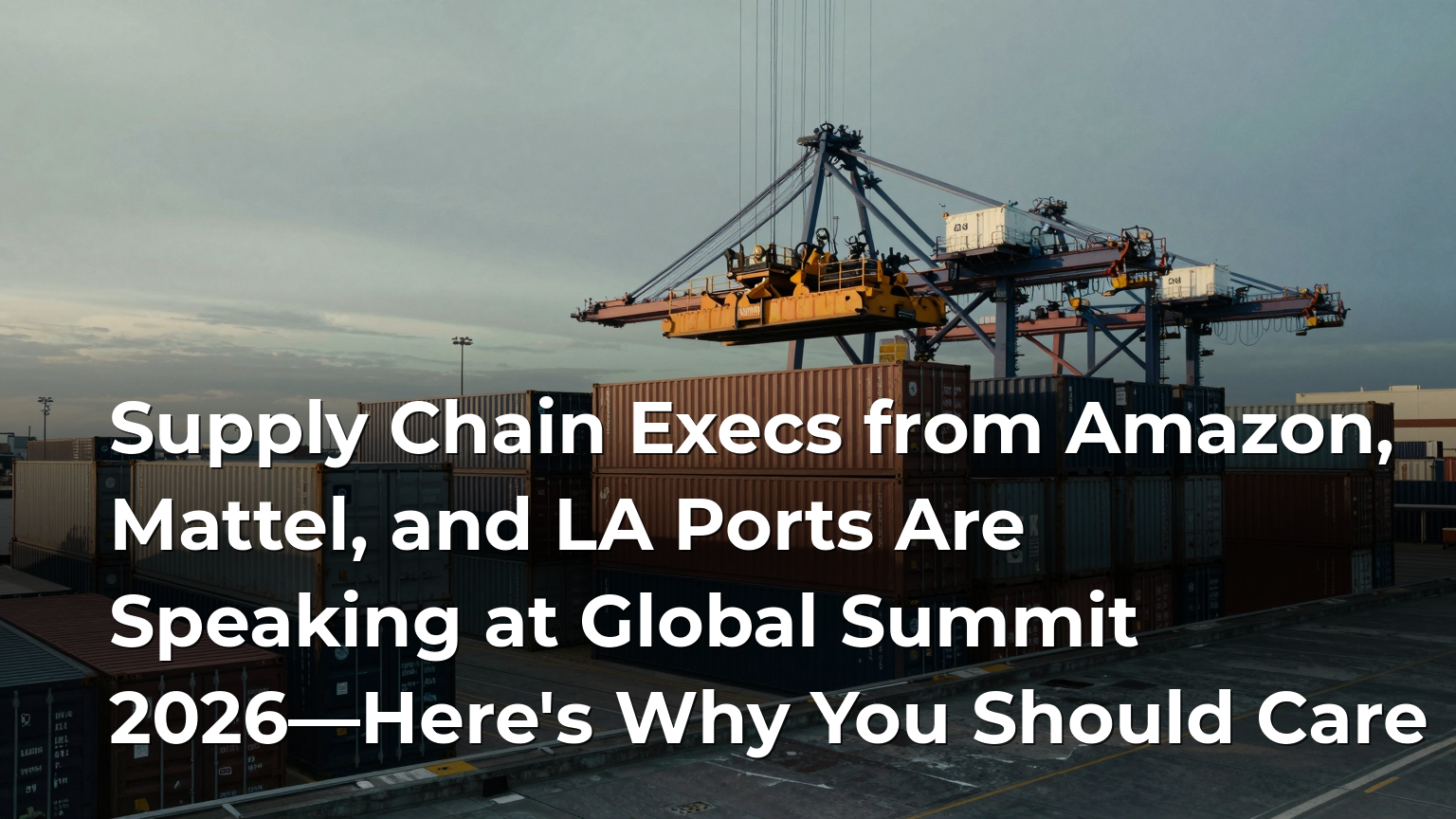
The Global Summit 2026 lineup is dominated by supply chain executives from Mattel, Amazon Canada, and the Ports of Los Angeles and Long Beach. If you sell into logistics, cross-border trade, or e-commerce fulfillment, this is a conference worth tracking even if you never buy a ticket. The talks are the intel. The speakers are the prospects.
Most founders treat a conference like this as a networking event. The sharper move is to read the agenda as a map of what your buyers are worried about in 2026, then write outbound that speaks to those worries before the event even opens.
What the speaker list actually tells you
Three names on the agenda do most of the work here.
Mattel is a toy manufacturer with a supply chain that runs through Asia, Latin America, and a dozen tariff regimes. When a Mattel supply chain exec gets a keynote slot, the topic is almost always cost structure under geopolitical pressure. That's a company that has spent the last few years re-routing production and renegotiating freight. If you sell anything that touches landed cost, customs, or supplier visibility, Mattel is a live account.
Amazon Canada is the fulfillment story. Canada is a smaller market with different carrier economics, different labor rules, and a border that punishes sloppy paperwork. An Amazon Canada exec on stage is going to talk about cross-border fulfillment and last-mile cost. If your product helps sellers or brands move inventory into Canada without bleeding margin, that talk is your pitch deck in reverse.
The Ports of Los Angeles and Long Beach are the two busiest container ports in the US. Together they handle roughly a third of American containerized imports. When port leadership speaks, the subtext is throughput, congestion, and the automation question. Ports are slow-moving buyers with long procurement cycles, but they set the tone for everyone downstream. If the ports are talking about AI-driven yard management, every drayage company and freight forwarder in the room is going to start budgeting for it.
Three themes to build outbound around
The agenda clusters around geopolitics, e-commerce fulfillment, and AI transformation. Each one maps to a different buyer and a different pain.
- Geopolitics — tariffs, re-shoring, and supplier concentration risk. Buyers here are VPs of supply chain and procurement leads. They care about scenario planning and cost modeling. The regulatory layer is where the real work sits: tariff classification decisions, rules-of-origin documentation, and duty drawback claims all require audit-ready records, and re-shoring a supplier means rebuilding that paper trail from scratch. A message that acknowledges the compliance burden behind the headline — not just the headline — signals you understand the job.
- E-commerce fulfillment — cross-border shipping, returns, and last-mile economics. Buyers are ops directors at DTC brands and marketplace sellers. They care about per-order cost and delivery promise accuracy. Cross-border adds customs brokerage, de minimis thresholds, and VAT collection to every order, and returns compound it: a returned international order can cost more to process than it earned. Speak to the per-order math, not the channel strategy.
- AI transformation — demand forecasting, yard automation, and document processing. Buyers are COOs and heads of digital. They care about proof, not demos. Forecasting and document extraction both fail quietly at the edges — unusual SKUs, handwritten bills of lading — so reference the validation question. A buyer who has been pitched ten pilots wants to know how you measure accuracy before scale.
Pick the theme that matches your product. Then write a sequence that references the specific talk, not the conference in general. "Saw your panel on cross-border fulfillment at Global Summit" beats "hope you enjoyed the conference" every time. The same discipline applies to the follow-up: name the operational detail from the session, connect it to a problem you know they own, and ask one question about how they handle it today. That specificity is what separates a reply from a delete.
How to work a conference you're not attending
You don't need a badge to get value from a lineup like this. The speaker list is public. The agenda is public. The companies are public. That's enough to build a targeted list.
Here's the workflow we'd run. Pull the speaker roster and the companies they represent. Filter to the titles that match your ICP. Enrich for direct emails using whatever tool you trust. Then write a short, specific opener that references the talk topic and asks a question the speaker would actually answer. No calendar links in the first email. No "quick call" asks. Just a relevant observation and a question.
The sequencing matters more than the copy. Conference-timed outbound has a natural three-window structure: a pre-event touch that references the session topic while the speaker is still preparing remarks, an at-event touch only if you have something genuinely useful to add to the conversation, and a post-event touch that references what was actually said. Most teams skip the first window and over-invest in the second, which is backwards. The pre-event window is when a speaker's inbox is calmest and when a well-framed question about their panel topic reads as preparation rather than pitch. The post-event window works because conference talks generate follow-on coverage — recaps, quotes, panel write-ups — that gives you a legitimate reason to reopen the thread with a specific reference instead of a generic check-in.
We've written before about how most SDRs treat a 6,946-conference calendar as a tourist trap rather than a prospect list. The same logic applies here. The value isn't in attending. It's in reading the agenda like a buyer-intent signal and acting on it before the event.
One caveat. Conference-timed outbound works best when your product is genuinely adjacent to the theme. If you sell HR software, a supply chain summit is noise. If you sell freight visibility or customs automation, it's a gift. Be honest about which one you are.
What to watch for after the event
The real signal comes in the two weeks after the summit. Speakers publish recap posts. Companies issue press releases about partnerships announced on stage. Attendees write LinkedIn summaries. That's when you get the specifics you can't get from the agenda: which initiatives got budget, which vendors got named, which problems got escalated.
Watch for the gap between what was said on stage and what gets written down. A supply chain executive who mentions "exploring nearshoring options" during a panel is signaling intent; the same executive whose company files a recap post naming specific ports, vendors, or timelines is signaling commitment. That distinction matters for outbound because it tells you whether a prospect is in evaluation mode or execution mode — and the two require different first-touch language. Evaluation-mode prospects respond to framing around tradeoffs and risk. Execution-mode prospects respond to framing around implementation speed and integration fit.
Pay attention to regulatory and process language in particular. Supply chain conversations at events like this tend to surface friction points before they become public: customs classification changes, compliance audit timelines, carrier contract cycles, port throughput constraints. When a speaker references a process bottleneck in passing, that's often the most actionable detail in the entire session — it's a problem they're actively trying to solve, and it's specific enough to anchor a relevant outreach message.
Set a reminder for the week after the event. Scan the recap content. Note who published specifics versus who stayed vague. Update your sequences with the actual language the speakers used — their phrasing, their priorities, their named constraints. That's the difference between outbound that sounds like you were there and outbound that sounds like you scraped a list.
If you want to see how MiraReach handles conference-driven prospecting, from speaker-list enrichment to personalised first-touch drafts, give MiraReach a try. The human still presses send.
— Mira