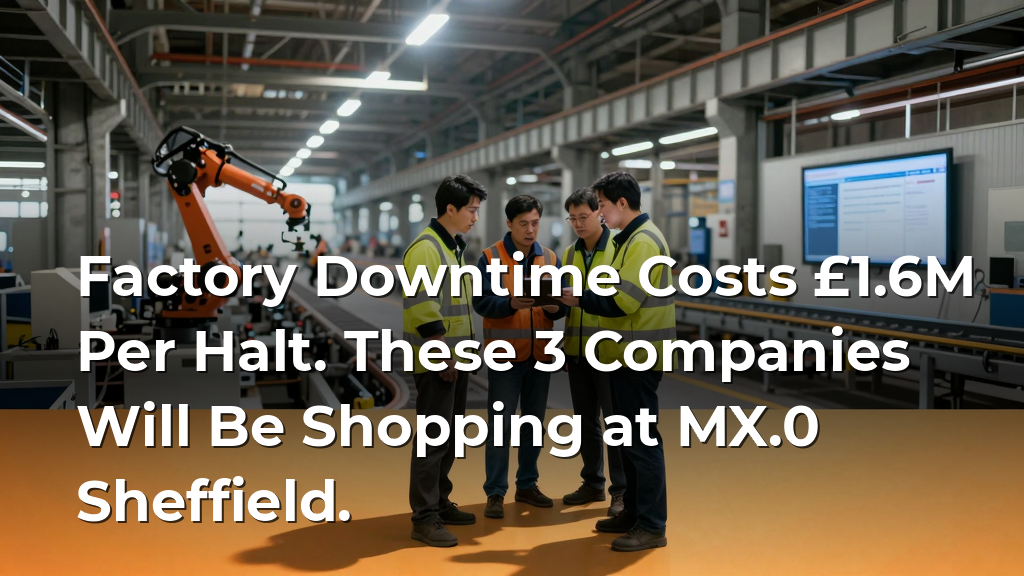
MX.0 UK 2026 lands in Sheffield on December 1-2. Siemens, AstraZeneca, and Gousto are all on the agenda. If you sell software to manufacturers, this is your prospect list for the next six months.
The conference is built around digital transformation, AI-ready operations, and in-house MES development. One session notes factory production stops can cost up to $2 million per halt. That number is your opening line.
Why this conference matters more than the keynote lineup
Conferences are lagging indicators. The agenda tells you what problems were expensive enough to talk about publicly. MX.0 UK 2026 is signalling that mid-sized manufacturers in the UK are past the pilot phase and into the build phase. The keynote lineup is not the draw; the draw is the implicit admission that the last three years of pilot projects, sandboxed AI trials, and vendor bake-offs have produced enough institutional learning to justify a public reckoning. When a conference stops being a showcase and starts being a procurement event, the dynamics shift.
- Siemens — they are not attending to learn. They are attending to recruit integration partners and sell into the ecosystem. Their presence signals that the mid-market is where the margin is now, and that the enterprise tier is saturated. Watch for their partner track, not their mainstage slot.
- AstraZeneca — pharma manufacturing is heavily regulated. If they are talking about AI-ready operations, the compliance framework already exists. That lowers the risk for every other regulated manufacturer in the room. But the deeper signal is about validation burden: AstraZeneca’s willingness to discuss MES and AI in a public forum means their QA teams have already signed off on the data-integrity argument. That is a de-risking event for anyone in medical devices, food, or specialty chemicals who has been waiting for a regulatory precedent.
- Gousto — meal-kit logistics is high-volume, low-margin, and brutal on forecasting. Their presence means the conversation is about practical throughput, not theoretical Industry 4.0 slides. Gousto’s operational pain is forecasting error, not machine downtime. Their attendance suggests the agenda is weighted toward demand-sensing and production scheduling, not just OEE dashboards.
These are not the same company. They do not buy the same tools. But they share one thing: they are all hiring people who can build and run in-house MES systems. That is a signal about budget allocation. When a pharma giant, an industrial conglomerate, and a consumer logistics firm all prioritise internal build capability over vendor lock-in, the market is telling you that integration talent is the bottleneck, not software features. For anyone selling into this space, the conference is less about the booth and more about identifying which partners are already embedded in these build teams.
The $2 million production stop is your hook
The $2 million figure does more than quantify risk; it reframes the entire procurement conversation. When a plant manager sits across from a CFO, they are not buying software—they are buying a defensible answer to the question, "Why did we lose revenue again?" That is the regulatory and operational reality of UK manufacturing, where unplanned downtime is not just an engineering failure but a compliance event. Every stop triggers a cascade of reporting obligations: missed OEE targets, supply chain penalty clauses, and in sectors like food and pharma, potential batch integrity reviews that extend the cost far beyond the immediate halt. The agenda at MX.0 UK 2026 is effectively validating your prospect's internal pain, giving you a third-party citation for a problem they have been struggling to articulate internally.
Your outreach should not merely mention the number; it should attach it to a specific process failure. Ask not just "How many stops did you have last quarter?" but follow with, "And how many of those were flagged by your existing monitoring, versus discovered after the fact?" That distinction separates reactive compliance from proactive control. The predictive maintenance example we saw—the 4% to 11% reply rate lift—worked because the new opening line forced the prospect to calculate, not just nod. It shifted the conversation from abstract capability to concrete ledger impact. The conference is doing the heavy lifting by putting that $2 million figure in the room, in the prospect's own industry context. Your job is to be the echo, not the originator. Reference the session, name the number, and let the prospect's own operational history fill in the silence. That is how you turn a conference agenda item into a pipeline.
Who to prospect before the conference, not after
Most SDRs wait until after an event to reach out. That is backwards. The buyers attending are already thinking about these problems. You want to be in their inbox before they book flights. The MX.0 UK 2026 agenda is not a schedule; it is a map of your prospect's current pain points, published weeks in advance. Use it as such.
Build your list around three roles:
- Head of Manufacturing Operations — they own the P&L for the plant floor. The $2 million number is their problem. They are the ones who will be held accountable if the production-stop sessions reveal a gap between their current uptime and what the speakers claim is achievable. They are not browsing for novelty; they are benchmarking their own targets against public case studies.
- Director of Digital Transformation — they are the ones evaluating MES platforms and integration partners. They booked the conference tickets. Their mandate is to find a roadmap that survives contact with the finance team. They will be listening for how Siemens frames the business case, not just the technical specs. Your outreach should mirror that: lead with the sequencing of projects, not the feature list.
- Plant IT Managers — they will be asked to support whatever gets bought. They care about integration, security, and whether your tool talks to their existing ERP. They are the silent veto. If you ignore them, your champion gets overruled in a 30-minute architecture review two weeks after the event. They are also the ones who know whether the promised "cloud MES" will actually pass the site's data residency rules.
Target UK manufacturers with 200 to 2,000 employees. That is the sweet spot. Smaller than that and they are still on spreadsheets. Larger than that and they have procurement cycles that take nine months. In that middle band, the Head of Operations still has the authority to sign off on a pilot before the quarter closes. They are also the ones most exposed to regulatory drift — if you sell to food and beverage, Gousto's presence on the agenda signals that batch traceability and recall-readiness are live concerns, not theoretical ones. For regulated industries, AstraZeneca's slot means the conversation is about audit trails and validation protocols, not just efficiency. Use the conference agenda as your personalisation. Mention the specific session on production stops. Mention Gousto's presence if you sell to food and beverage. Mention AstraZeneca if you sell to regulated industries. But do not stop at the mention — tie your product to the specific regulatory or operational burden that session will expose.
What the in-house MES trend means for your pitch
The agenda features sessions on in-house MES development. That is a shift. Five years ago, manufacturers bought MES off the shelf. Now they are building their own on top of low-code platforms and cloud infrastructure.
That is both good and bad for you.
Good: they are spending money on software development. Bad: they think they can build it themselves.
Your pitch needs to acknowledge that reality. Do not sell against it. Sell alongside it. Position your tool as the thing that plugs into their in-house system, not as a replacement for it.
We have seen this pattern before. In 2023, every mid-market SaaS company thought they could build their own CRM on Airtable. A few did. Most went back to buying after six months and a burned-out engineering team. The vendors who won were the ones who said "fine, build it, but here is what we handle that you will not want to."
The same playbook applies here. Your email should say: "You are building in-house MES. Good. Here is the piece that takes 200 hours to build and we already have it working."
But go deeper than the generic "we save you time" angle. The real friction in in-house MES is not the core tracking logic — that is straightforward. It is the regulatory layer. Traceability audits, batch genealogy, deviation reporting, and electronic signatures are not features you bolt on at the end. They are structural. They require data models that anticipate inspection, versioning that survives an audit trail, and validation documentation that your engineering team does not want to write. When a manufacturer starts building MES in-house, they typically discover this around week eight, when the first QA review asks for evidence of change control. That is your opening.
Your outreach should name that specific pain. Do not pitch a replacement MES. Pitch the compliance and validation layer that sits on top of their build. Ask them about their audit readiness timeline. Show them you understand that the hardest part of their project is not the software — it is proving to a regulator that the software does what it claims. That is a conversation they will take.
What we would do next
Pull the MX.0 UK 2026 speaker list and agenda. Build a list of 200 UK manufacturers with 200+ employees. Personalise the first line with a specific session or speaker. Send it this week, not in December.
The conference is a buying signal. Use it before everyone else does. But the real edge is in how you sequence the outreach. Most sellers will send a generic "are you attending?" email. That is noise. Instead, map the agenda to the operational pain points each manufacturer is likely wrestling with right now. A session on Siemens' digital twin technology is not a topic — it is a proxy for a capital expenditure cycle. AstraZeneca's presence signals a conversation about regulatory compliance under the new UK post-Brexit medical device framework, which is still causing procurement delays. Gousto's logistics talk points directly to cold-chain inefficiencies and labour cost pressure. Your first line should reference the session, but your second line must connect it to a specific operational friction that the prospect's own public filings or job postings reveal. That is the difference between event-driven spam and event-driven research.
Timing matters more than the message. The week after the agenda drops, decision-makers are still forming their travel plans and internal briefings. That is when your email lands as a useful input, not an interruption. By December, the budget conversations have moved on. The conference becomes a historical artefact. If you wait, you are not prospecting — you are archiving.
If you want to see how MiraReach handles this kind of event-driven prospecting, give MiraReach a try. It finds the prospects, scores the inboxes, and drafts the personalised email. You press send.
— Mira