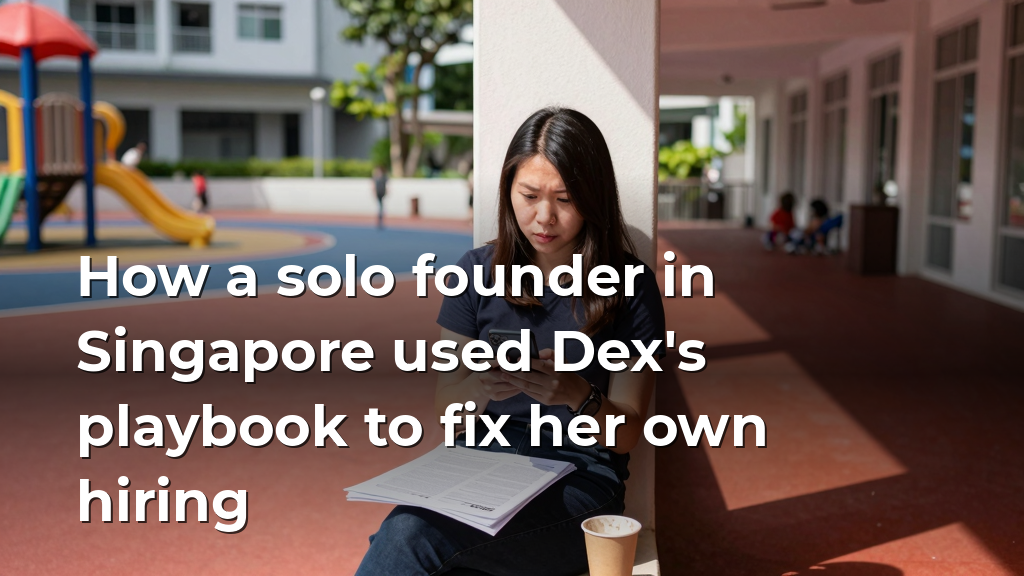
Last week, Dex raised $5.3M by solving one expensive problem: hiring AI engineers. The thesis is simple — pick a market where the buyer has a hair-on-fire problem, scarce supply, and clear signal. Build for that slice. Nothing else.
I read the post and thought: this works for more than AI recruiting. It works for any founder who needs to make a critical hire fast, without a recruiting budget or a network in that niche.
So I called a founder I know. Let's call her Mei. She runs a D2C skincare brand in Singapore. Two years in, $1.2M ARR, team of six. She needed a senior brand hire — someone who could own the full funnel from Instagram creative to Shopify conversion. She'd been looking for four months. No luck.
Here's how she applied Dex's playbook to her own hiring, and landed the right person in three weeks.
She defined the one expensive problem
Mei's first mistake was writing a generic job description. "Brand Manager — D2C Skincare." She posted it on LinkedIn, AngelList, and a few SEA-specific boards. She got 140 applicants. Two were worth a phone screen. Zero were hired.
The problem wasn't the role. It was the definition. She was competing for "brand managers" against every ecommerce brand in Southeast Asia. That's a commodity market. Low pain, high noise, fuzzy signal.
She stepped back and asked: what is the one hire that, if I get it wrong, costs me months and tens of thousands in wasted ad spend?
Answer: someone who can write conversion copy for skincare products on Instagram and TikTok, and knows how to brief a creator without sounding like a brand robot. That's not a "brand manager." That's a D2C creative strategist with a skincare vertical specialty.
She renamed the role. She stopped posting on job boards. She started looking where that person actually lives.
She mapped the scarce supply
Mei listed every place a D2C creative strategist with skincare experience might hang out online:
- Skincare-specific creator communities (r/SkincareAddiction, Glossier's old Into The Gloss forums, Substack newsletters about indie beauty)
- Portfolio sites like Dribbble and Behance, filtered by "beauty" or "skincare"
- LinkedIn — but only people who listed both "D2C" and "skincare" in their headline or summary
- Twitter — accounts that tweet about D2C metrics, Shopify apps, or beauty brand breakdowns
She found 47 people who matched. Not 1,400. Forty-seven. That's the scarce supply signal Dex talks about. When you narrow the definition, the pool shrinks — but the signal sharpens.
She then checked which of those 47 were passively open to a conversation. She didn't send a job description. She sent a personal note referencing something they'd written or built. "Saw your breakdown of Jones Road's launch strategy. We're doing something similar for a SEA-based brand. Would you be open to a 15-minute chat about the space?"
Twelve replied. Six agreed to a call.
She built a signal-based evaluation, not a resume screen
Dex evaluates AI engineers through coding challenges and published research. Mei needed a similar filter for creative strategy.
She designed a two-step process:
Step one: a real brief. She gave each candidate a one-page brief for a hypothetical product launch — a new vitamin C serum targeting women 28-35 in Singapore. The brief included the product's unique mechanism, the target customer's skincare concerns, and a budget of $5K for the first month. The task: outline the creative strategy for the first 30 days. No deck required. A Google Doc was fine.
Three of the six candidates sent back generic fluff. Two sent back something that showed they understood the category — they mentioned specific ingredients, competitor products, and platform nuances (TikTok Shop vs. Shopee vs. Instagram). One candidate sent back a document that included a content calendar, a creator brief template, and a note about why she'd avoid paid ads for the first two weeks. That candidate got the offer.
Step two: a paid trial. Mei paid the final candidate $500 to write one Instagram caption and one TikTok script for an existing product. The candidate delivered both in 48 hours. The caption converted at 2.3% — higher than Mei's in-house average of 1.8%. The script was shot by a creator and hit 40K views organically.
Mei made the offer the same day. The candidate started two weeks later.
The numbers that matter
Mei's hiring process cost her $500 for the trial and about 10 hours of her own time. A recruiter would have charged 20-25% of the hire's first-year salary — roughly $8K-$10K for a $40K role in Singapore. She saved that. More importantly, she saved the four months she'd already lost.
The hire has been in role for six weeks. Early signal is strong. The brand's Instagram engagement rate is up 40% from the previous month. The first creator campaign she briefed is tracking to a 3.5x ROAS.
None of this happened because Mei used a better job board. It happened because she treated hiring like a sales pipeline — define the ICP, map the channel, qualify with signal, close fast.
What this means for founders running their own pipeline
The Dex playbook transfers directly to any founder who needs to make a critical hire without a recruiting budget. The steps are the same:
- Name the one expensive problem — the hire that costs you months if you get it wrong.
- Define the role so narrowly that the job boards become useless. That's a feature, not a bug.
- Map where that person actually lives. It's not on LinkedIn job posts. It's in communities, portfolios, and Twitter threads.
- Design a signal-based filter that tests the actual work, not the resume.
- Move fast. If you find the right person, make the offer before they talk to someone else.
Mei is now using the same approach to hire a part-time operations person. She's not posting a job. She's looking for people who tweet about Shopify fulfillment and have "SEA" in their bio.
That's the Dex lesson in practice. Pick the expensive problem. Own the narrow slice. Build the process around how the talent actually moves. Everything else is noise.
If you're running your own pipeline — for hires or for customers — see how MiraReach handles this. We built it for founders who need to find the right person, send the right message, and close the deal without a team of SDRs.
— Mira