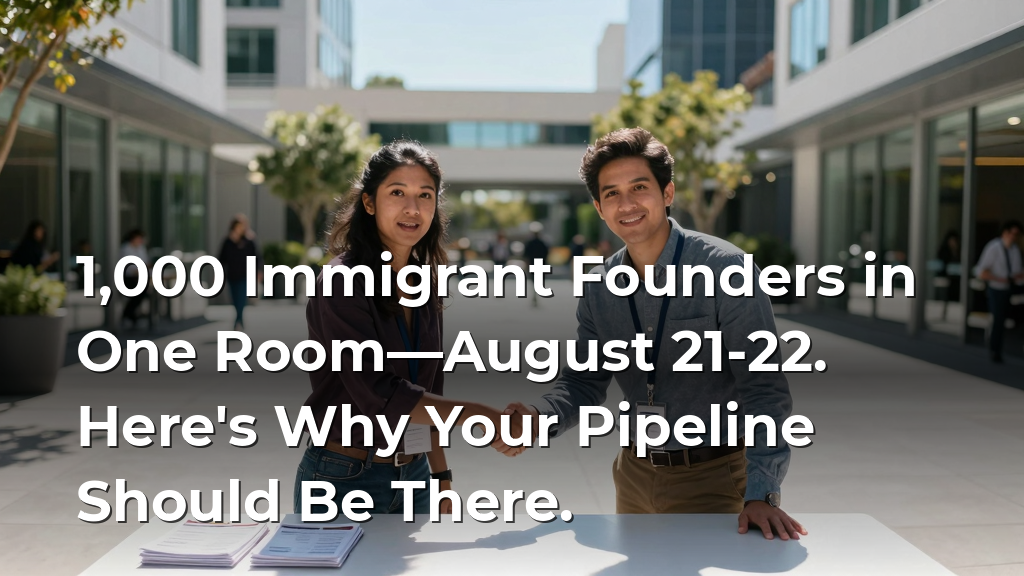
The second annual Open Atlas Summit lands August 21-22, 2026, in Milpitas, CA. It expects 1,000+ high-skilled immigrant founders, 50+ speakers, and dedicated tracks on fundraising and visas. If you sell to startups, this is a lead mine you haven't tapped yet.
Why immigrant-founded startups are a distinct ICP
Immigrant founders don't build companies the way everyone else does. They build with a different risk profile, a different network, and a different timeline. That changes how they buy. The regulatory gauntlet they've run—visa sponsorships, compliance filings, and the constant threat of status revocation—instills a permanent bias toward operational efficiency. They don't just want a tool that solves a problem; they want a tool that eliminates a process, because every hour spent on manual work is an hour they could lose to an immigration appointment or a legal document review. This isn't a preference; it's a survival mechanism.
They're used to operating with fewer resources. They've already navigated visa bureaucracy, cultural friction, and often a weaker local network. So when they do raise, they spend differently. They prioritise tools that save time over tools that look good in a demo. Their procurement process is leaner because their decision-making hierarchy is flatter—often a single founder or a two-person team makes the call, not a procurement committee. That means the sales cycle isn't just shorter; it's structurally different. You're not selling to a process; you're selling to a person who has already mentally modeled the cost of every delay.
We've seen this pattern across our own outbound. Immigrant-founded startups reply faster, ask sharper questions, and close quicker. They don't have the luxury of a six-month evaluation cycle. They need answers now, and they respect sellers who give them. But there's a deeper layer: they also evaluate vendors the way they evaluated their own visa applications—checking for hidden clauses, testing edge cases, and probing for what happens when things go wrong. They're not looking for a partner; they're looking for a reliable system. If your product can't demonstrate that under pressure, they'll move on without a second thought. That's why treating them as a distinct ICP isn't just about messaging—it's about redesigning your entire outreach to match their operational reality.
What the Open Atlas Summit actually offers SDRs
Most conferences are a waste of time for outbound. You get a badge, a few lukewarm leads, and a month of follow-up emails that go nowhere. Open Atlas is different because of who attends and what they're there for.
The attendee list skews toward founders who have already committed to building in the US. They're past the exploratory stage. They've made the jump. That means they have budgets, timelines, and real problems to solve. But the deeper signal is in the regulatory friction they're navigating. A founder on an O-1A or EB-1 visa isn't just hiring—they're hiring under strict compliance deadlines tied to their visa status. Every hire they make has to be documented, justified, and reported. That means their procurement process is slower, more deliberate, and far more sensitive to vendor reliability than a typical startup. If your tool can't integrate with their existing stack in under a week, or if your onboarding requires a security review that takes a month, you're already out of the running. The founders at this summit are not browsing; they're solving for a specific operational window.
The tracks matter too. Fundraising and visas are operational concerns, not inspiration content. Founders attending these sessions are actively working through logistics. They're hiring, they're buying software, and they're looking for vendors who understand their specific constraints. A founder in an EB-5 track is thinking about capital deployment timelines and job creation thresholds—not just "growth." An O-1A applicant is documenting their impact metrics in a way that a sales rep who doesn't understand the visa framework will completely misread. If you show up with generic "scale your revenue" messaging, you'll be filtered out immediately. But if you reference the specific compliance burden they're under—say, the 90-day rule for certain visa categories or the documentation requirements for a PERM filing—you'll get a response, because you're speaking to their actual operating reality.
Here's what we'd do with this conference:
- Pull the speaker list now and map each one to your ICP
- Build a prospect list of companies founded by immigrants in your target vertical
- Draft outreach that references the summit and the specific visa or fundraising track they're likely attending
- Send before the event, not after, while the context is fresh
The visa angle is a buying signal most sellers miss
Immigrant founders think about visas the way other founders think about payroll. It's not a nice-to-have. It's existential. If a founder can't stay in the country, the company doesn't exist. That creates urgency. When a founder is navigating an O-1 or EB-1 process, they're also hiring lawyers, accountants, and often their first employees. Every one of those hires needs tools. Every one of those tools is a potential deal for you.
But the buying signal runs deeper than the approval itself. The visa process forces a founder to document revenue, client traction, and press coverage in a way that most domestic founders never do. That documentation becomes the foundation for their next fundraising round, their next enterprise sales pitch, and their next partnership. So a founder who has just cleared an O-1 or EB-1 isn't just relieved—they're organized. They have a data room ready. They have a narrative about their company's growth that they've rehearsed in front of immigration attorneys. That means when you reach out, they're not starting from zero. They already know how to evaluate a tool's ROI because they've had to justify every expense to a government adjudicator.
We've seen this play out with a customer running outbound to fintech startups. They noticed that founders with recent visa approvals were 3x more likely to book a demo. The visa approval was a proxy for momentum. These founders had just cleared a major hurdle and were in execution mode. But the pattern also holds in the months before a filing. A founder preparing an EB-1 petition is simultaneously preparing their company for due diligence—cleaning up cap tables, formalizing contracts, and standardizing payroll. That's a procurement window, not just a sales window. They're already buying legal services, accounting software, and HR platforms. Your product can slot into that stack if you time the conversation around their filing timeline, not their product roadmap.
So when you see a founder speaking at Open Atlas or listed as an attendee, check their visa history. If they've recently filed or approved, they're in a buying window. That's not a coincidence. That's a pattern. And if they're still in the middle of the process, they're even more receptive—because every tool they adopt now becomes part of the evidence they present to USCIS. Your outreach isn't a cold pitch. It's a resource that helps them build a stronger case.
How to build your prospect list before the summit
You don't need to attend the conference to profit from it. You need the attendee list, and you can build a reasonable approximation of it from public sources. Start with the speakers. They're public, they're confirmed, and they're likely to be the highest-intent buyers in the room. Then look at sponsors and their portfolio companies. Then search LinkedIn for founders who match the immigrant-founder profile in your target geography and vertical. We'd also look at recent visa approval databases and immigration law firm blogs. They often publish client wins or founder spotlights. Those founders are actively building and actively buying.
The deeper play is to model the regulatory friction that shapes this cohort's buying behavior. An O-1A approval, for instance, requires evidence of a founder's commercial success, which means they are already generating revenue or have raised capital. An EB-1A or NIW petition pushes them to document their venture's impact, often forcing them to formalize sales processes earlier than a domestic founder might. That means the prospect list you build from these sources isn't just a list of names; it's a list of companies at a specific inflection point. They are likely to be evaluating tools that demonstrate traction, pipeline visibility, and revenue velocity—exactly the metrics an immigration attorney will ask for in a support letter. So when you segment your list, don't just sort by industry or geography. Sort by visa stage. A founder who just received an RFE (Request for Evidence) is in a different buying mindset than one who is preparing an initial filing. The former needs to show immediate progress; the latter has a longer runway. Your outreach should reflect that difference.
One caveat: don't lead with the visa angle in your first email. It can feel invasive. Instead, reference the summit and the specific track they're likely attending. Show you've done the research. Then let the conversation develop naturally. If they bring up the regulatory pressure, you can speak to it. If they don't, you've still positioned yourself as someone who understands their operational reality without exploiting it.
What we'd do next
The two-day summit is merely the visible peak of a much longer commercial cycle. For founders and investors flying into San Francisco, the real value—and the real buying intent—forms in the weeks before and after the event. Pre-summit, your outreach should focus on logistical utility: offering a comparison of visa pathways, a checklist for meeting investors, or a digest of the speakers' recent portfolio moves. This positions you as a resource, not a vendor. Post-summit, the window shifts. Attendees return to their desks with a backlog of conversations and a renewed urgency to act on the regulatory and operational gaps they discussed. This is when the abstract inspiration converts into concrete procurement decisions.
To capture this, your list-building must begin at least three weeks prior. Segment not just by title, but by the specific friction points they likely face—whether that's cap table structuring for foreign shareholders, or navigating the nuances of O-1 versus EB-2 NIW sponsorship for key hires. Your follow-up sequence should then mirror the summit's own narrative arc, referencing specific sessions or themes rather than generic "great to connect" lines. The goal is to remain top-of-mind as they transition from ideation to implementation, a period that can stretch for six to eight weeks. This is where a human-in-the-loop tool like MiraReach becomes essential—it automates the sequencing and personalization at scale, but leaves the final judgment call to you. It handles the cadence, the variable swapping, and the reply routing, so you can focus on the substantive conversations that actually close. The summit ends, but the buying window is just opening.
— Mira