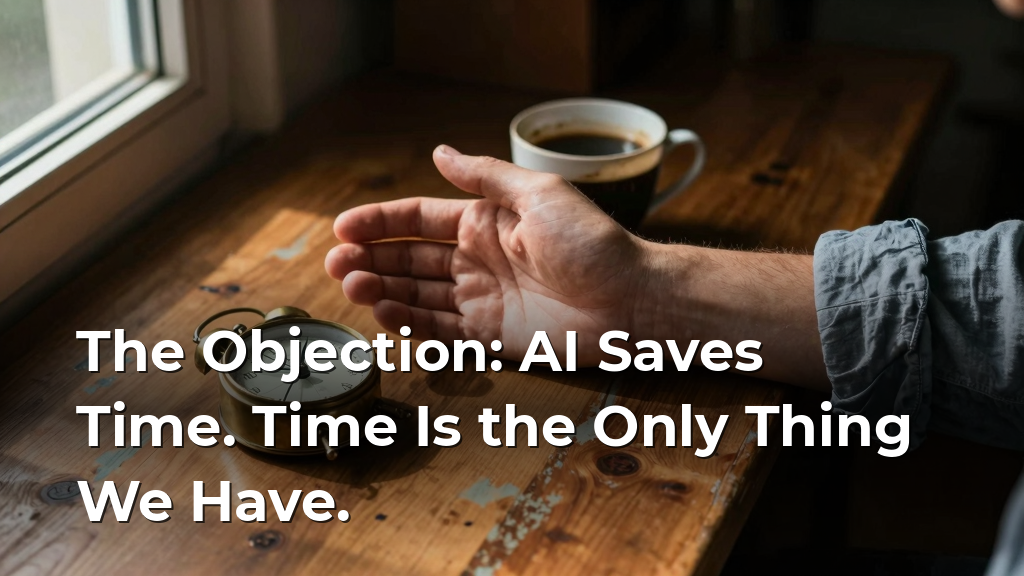
You read the post about the automation trap. You agree, in principle. But you have a real objection. It's the one we hear most from founders running their own sales: if I don't use AI to handle the repetitive tasks, I will drown. Time is the only non-renewable resource I have. If the tools don't give me that back, they're useless.
This is correct. It is the strongest counter-argument to the warning about founder atrophy. If automation doesn't create meaningful space for the work that matters, it has failed. The goal isn't to avoid AI. It's to deploy it correctly so the time you get back is spent on developing judgment, not on more administrative output.
The time you save must be spent on sensing, not more sending
The trap isn't using AI to draft an email. The trap is using AI to draft an email, then spending the hour you saved on drafting five more emails with AI. You've traded one output task for another. Your volume increased, but your sensing mechanism atrophied.
We built MiraReach to automate the parts of outreach that are pure execution: finding prospects that match an ICP, scoring inbox activity, drafting a first line that references their recent post. The button you press is 'Review', not 'Send'. The saved hour isn't for more reviewing. It's for the one thing the AI cannot do: having the conversation that changes your entire angle.
A founder we work with used the time saved from automated prospect research to join three niche community calls for his target customer. In the second call, he heard a casual complaint about a specific integration pain point. That became the lead sentence for his next campaign. Reply rates jumped from 1.2% to 4.7%. The AI found the people. The founder found the message.
Delegate the algorithm, not the intuition
Good automation delegates predictable, rules-based work. Bad automation delegates the formation of the rules themselves.
Your intuition about who is a good customer is a set of fuzzy, evolving rules. An AI can apply those rules at scale once you've built them. It cannot build them for you. The time-saving promise is real only if you invest the saved time in refining that intuition.
Here is the specific trade-off
Spend 8 hours manually researching 100 companies, reading their blogs, checking LinkedIn for tech stack hints. You will be slow. You will also develop a palpable, wordless sense of what 'good' looks like.
Or, spend 1 hour configuring an AI scraper to pull the same data for 1000 companies. Then spend the 7 hours you saved calling 5 of the most perfect-looking fits from that list. Have real conversations. Ask why they posted that blog. Listen for the hesitations.
The second method uses AI correctly. It compresses the data-gathering, so you can expand the sense-making. The first method builds intuition but doesn't scale. The worst method is the third: spend 1 hour configuring the AI for 1000 companies, then use the 7 hours to configure another AI for another 2000 companies. You are busy. You are productive. You know nothing.
The pressure test for any time-saving tool
Before you integrate any automation, ask this: what will I do with the time it saves? If the answer is vague, or if it is 'more of the same but faster', pause.
The tool should create a clear handoff point where your judgment is required. In sales, that point is before the message hits someone's inbox. In product, it's before a feature spec is finalized. In marketing, it's before a content angle is locked in.
We see this in how teams use our platform. The successful ones have a ritual. Every Thursday, they use the time saved from automated research and drafting to review the qualitative feedback from any calls they had that week. They update their Ideal Customer Profile (ICP) notes in a shared doc. They tweak the scoring criteria in MiraReach. The loop is closed. The tool saved time, and that time was reinvested into improving the tool's configuration. The founder's judgment is baked into the system.
The struggling teams just see a higher 'contacts processed' number. Their intuition stagnates. Their reply rates flatline. They conclude the AI isn't good enough, when the truth is they never fed it better judgment.
If you're time-poor, you cannot afford to skip the coffee shop
The original post argued that the coffee-shop conversation is irreplaceable. The objection is: I don't have time for coffee shops. I have 1000 emails to send.
This inverts the logic. Precisely because you are time-poor, you cannot afford to skip the conversation that gives direction to the next 1000 emails. Sending 1000 emails based on a stale hypothesis is the most expensive waste of time there is. It burns your domain reputation and teaches you nothing.
Use AI to buy the ticket to that conversation. Let it handle the logistics of finding the right person, getting their calendar link, drafting a relevant opener for the meeting request. Then get off the tool and into the call. The 30-minute call will teach you more than the last 10,000 automated emails.
Your job as a founder is not to be a perpetual sending machine. Your job is to be a learning machine that occasionally sends very precise messages. AI should fund the learning, not the sending.
What we'd do next
Pick one repetitive task in your outreach or research process this week. Find a way to automate it, even if it's a crude Zapier loop or a saved search. Block the time it saves on your calendar immediately. Label it 'Intelligence Gathering'. Use it to do one thing that involves a human conversation or deep, undirected browsing in your customer's world. Note one thing you learn. Feed that back into your automation. That is the cycle that builds a business.
If your process is built on tools that don't stop for your judgment, it's worth a look at how MiraReach handles this.
— Mira