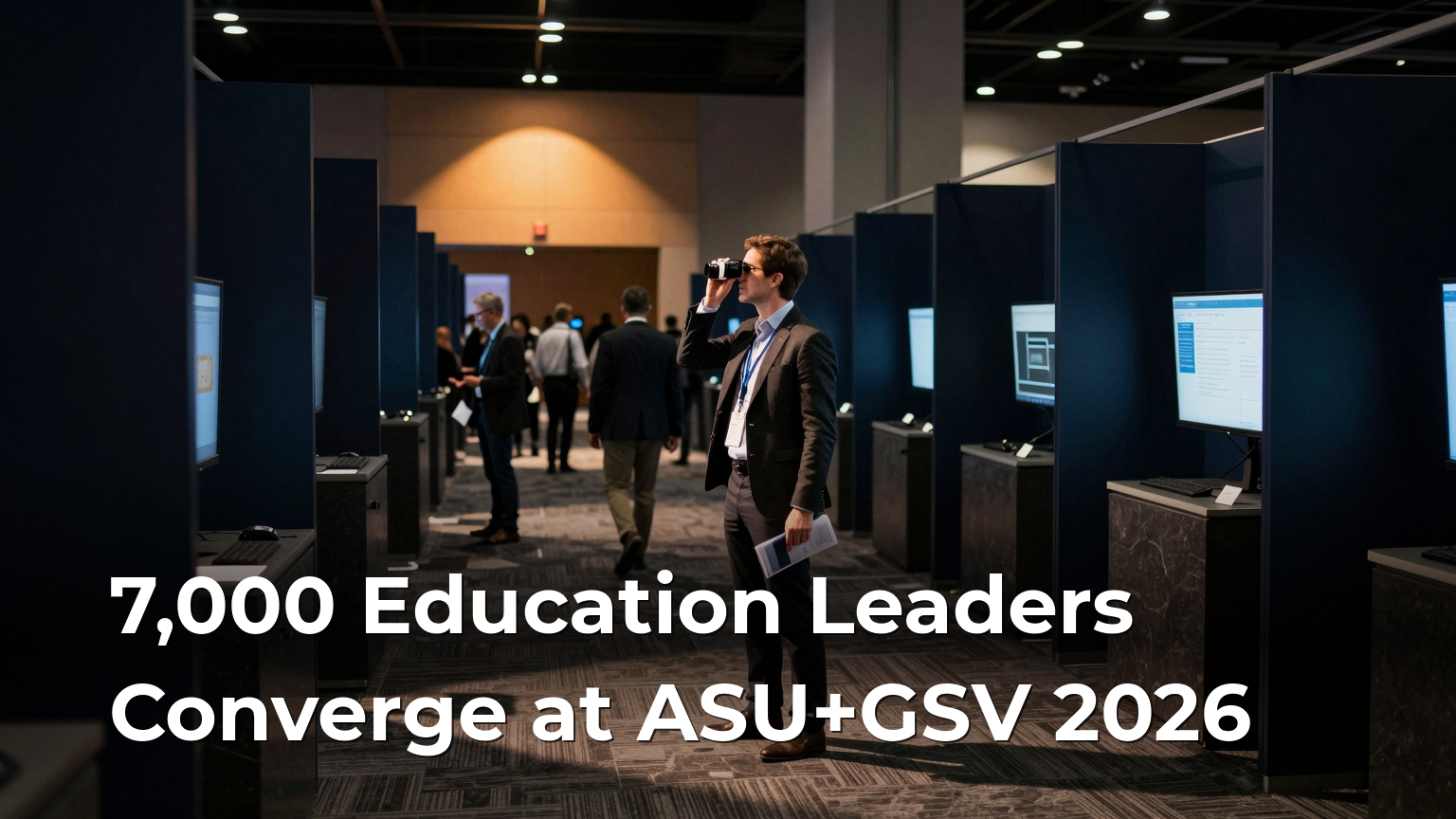
Two conferences in 2026 are worth your travel budget: ASU+GSV Summit and SXSW EDU. The other thirteen on the standard higher-ed circuit are a networking tax. If you sell edtech or AI tooling into universities, those two events are where the people who sign contracts actually show up.
We've written about this before, and the pattern hasn't changed. What has changed is the buyer. In 2026, the person across the table isn't asking whether AI belongs in their institution. They're asking which vendor survives procurement, which one clears their data policy, and which one their provost has already heard of. That's a different conversation, and it happens in a different room.
Why ASU+GSV and SXSW EDU carry the weight
ASU+GSV is where institutional strategy gets discussed in public. Provosts, CIOs, and VCs running edtech portfolios are in the same hallway. The AI track has moved from speculative panels to case studies with budget numbers attached. If you sell into higher ed at any ACV above $25K, this is the one event where a single conversation can move a deal forward by a quarter.
SXSW EDU is the earlier-stage counterpart. Smaller, more founder-heavy, and closer to the product and pedagogy conversation. It's where you find out what institutions are piloting before it hits a procurement cycle. For a solo founder or a two-person sales team, SXSW EDU is often the better first trip because the rooms are smaller and the buyers are more accessible.
We covered the case for skipping the other thirteen in more detail in which two conferences actually move pipeline in higher ed. The short version: the rest are useful for brand presence and not much else.
The other thirteen, ranked by what they're actually for
This isn't a list of events to avoid. It's a list of events to attend with a specific job in mind. If you go to any of these expecting pipeline, you'll be disappointed. If you go expecting a specific outcome, some of them earn their keep.
- EDUCAUSE Annual Conference — the IT and infrastructure crowd. Good for security, LMS, and data-platform vendors. Slow buying cycle.
- Online Learning Consortium (OLC) Accelerate — online program directors. Useful if you sell to continuing-ed or distance-learning teams.
- UPCEA Annual Conference — professional and continuing education. Niche but high-intent audience.
- NACUBO Annual Meeting — CFOs and finance officers. The room where budget objections get resolved.
- AACRAO Annual Meeting — registrars and enrollment. Operational buyers, not strategy buyers.
- NASPA Annual Conference — student affairs. Rarely a software budget holder.
- AIR Forum — institutional research and analytics. Good for data and reporting tools.
- WCET Annual Meeting — digital learning policy. Small, policy-heavy.
- EDUCAUSE Learning Initiative (ELI) Annual Meeting — teaching and learning innovation. Early-adopter faculty, not procurement.
- SXSW EDU — already covered above. Founder-friendly.
- ASU+GSV Summit — already covered above. Strategy and capital.
- Bett UK — K-12 heavy, but the higher-ed AI track has grown. Worth a look if you're UK-based.
- Reimagine Education — awards-driven, smaller, good for visibility.
- Times Higher Education World Academic Summit — leadership and policy. Long sales cycle, high prestige.
- Global EdTech Startup Awards circuit — not a single event, but a useful signal for which founders are getting attention.
That's fifteen. Two of them are worth a flight. The rest are worth a day if they're in your city.
What to actually do before you book the trip
Conference ROI is decided before you leave. We've seen founders spend $4,000 on a booth and come back with a stack of badges and no pipeline. The fix isn't a better booth. It's a better list.
Pull the attendee list the moment it's published. Score it against your ICP. Build a shortlist of 40 to 60 names you actually want to meet, and send a personalised note two weeks out. Not a mass email. A real one, referencing a session they're speaking at or a paper they published. The reply rate on that approach is roughly ten times what you get from a booth scan.
If you're running outbound into higher ed at any volume, the deliverability rules still apply. We broke down the DMARC p=none threshold that kills you above 100 emails a day — worth reading before you fire off a pre-conference sequence to 500 names.
The AI conversation has changed, and your pitch needs to match
In 2024, an AI pitch to a university got a polite nod. In 2026, it gets a question about data residency, model provenance, and whether the tool has been through a vendor risk assessment. The buyers have done their homework. So should you.
Bring a one-page security summary. Know your subprocessors. Be ready to explain what happens to student data when a model is fine-tuned. The vendors who win in 2026 aren't the ones with the best demo. They're the ones who clear procurement without a six-week back-and-forth.
We wrote about how SaaS is being repriced around AI agents in 2026 — the same pressure is hitting edtech budgets. Institutions are consolidating tools, not adding them. Your pitch needs to be a replacement, not an addition.
What we'd do next
Book ASU+GSV or SXSW EDU. Pick one. Build a 50-name target list from the attendee roster. Send 50 personalised notes two weeks out. Track replies in a spreadsheet, not a CRM, until you have a reason to upgrade. If you want the list-building and personalisation handled for you, see how MiraReach handles this — it drafts the emails, you press send.
— Mira