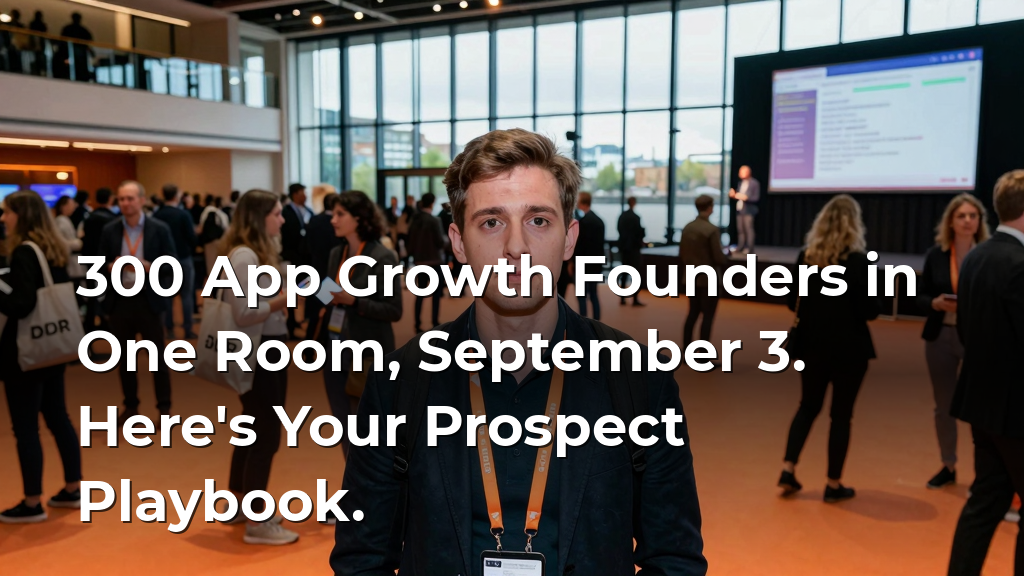
App Growth Summit London 2026 is confirmed for Thursday, September 3 at Tower Hotel. 300+ app growth experts, 30 speakers, 12+ sessions. If you sell into the app economy, this is the highest-density room of qualified prospects you'll find in the UK this year.
Why this conference beats the usual London tech circuit
Most London conferences are a mix of enterprise procurement managers and people who got free tickets from sponsors. App Growth Summit is different. The speaker list reads like your ICP list: growth leaders from Supercell, Vinted, Just Eat Takeaway, and Snap.
These are the people who own budgets for user acquisition, retention tooling, and analytics. They are not browsing. They are there to solve specific growth problems. That means they are open to conversations about tools that move metrics.
For founders and solo SDRs, this is a rare chance to compress a month of cold outreach into one day. You are not fighting for attention in an inbox. You are standing next to them at coffee.
The structural advantage here is the absence of procurement gatekeeping. At enterprise-heavy events, your technical pitch gets filtered through layers of vendor management before it reaches anyone who understands churn curves. At App Growth Summit, the person you need to convince is the same person who set the quarterly acquisition targets. That shortens your sales cycle from a six-week email sequence to a single conversation about their current attribution stack. The practical implication for your outreach strategy is straightforward: pre-book meetings with the speakers you know are attending, but also map the attendee list against your existing pipeline. If you have been nurturing a contact at a gaming studio for three months, their presence here is your excuse to move from LinkedIn messaging to a face-to-face walkthrough of your product’s dashboard. The cost of a ticket is negligible compared to the cost of another quarter of unanswered cold emails. The real value is the density of decision-makers in one room, all of whom have already signaled their intent to invest time in growth-related discussions. That is a filter you cannot replicate with any targeting parameter on LinkedIn.
What the agenda actually covers
The 12+ sessions are split across acquisition, retention, monetisation, and the AI layer that now sits on top of all three. Expect practical breakdowns of paid social performance, organic store optimisation, and lifecycle messaging that does not annoy users into churning. What is more interesting is how the agenda frames these as interconnected systems rather than isolated tactics. Acquisition without a retention loop is just paid churn; monetisation without personalisation is leaving revenue on the table. The AI layer is not a separate track — it is threaded through every session, which reflects where the industry actually is. Most teams are past the pilot phase and now wrestling with model governance, latency budgets, and how to measure incrementality when the algorithm is optimising for multiple objectives simultaneously.
Three sessions we would not miss:
- Supercell's session on creative testing at scale. They run more ad variants in a week than most teams run in a year. The takeaway will not be about volume — it will be about their kill criteria and how they structure creative hypotheses to avoid pattern-matching on winners that do not replicate.
- Vinted's talk on retention loops for marketplace apps. Second-hand fashion has brutal churn dynamics. Their playbook transfers to any two-sided product, particularly the tension between buyer and seller incentives and how you sequence engagement triggers without burning out either side.
- Snap's session on AI-driven personalisation. This is where the growth and product lines blur. If you sell AI tooling, this is your room. Expect a candid look at what happens when recommendation systems start optimising for session length over user intent — and how they are rebalancing those metrics.
The rest of the agenda is standard conference fare, but the standard here is higher than most. The organisers have a track record of curating operators, not vendors selling their own platforms. That means fewer case studies with cherry-picked results and more honest post-mortems on what did not scale. For a solo founder or small team, the value is in the frameworks, not the tools — and the agenda is structured to deliver those frameworks without the usual vendor pitch overlay.
How to work the room without being a vendor-zombie
We have attended enough conferences to know the failure mode. You collect 50 business cards, send a generic LinkedIn request the next day, and hear nothing back. That is not networking. That is littering.
Here is what works instead.
Before the event, pull the speaker list and the registered attendee list if it is public. Build a shortlist of 15 companies you actually want to talk to. Look up their current growth stack. Find the gap. Prepare one specific observation about their funnel, not a pitch. This is the critical distinction: a pitch is a demand for attention; an observation is an offer of signal. When you say, "I noticed your onboarding drops off after the credit-card step because your pricing page buries the annual option," you are not selling. You are demonstrating that you did the work. That is the entire currency of a room full of operators who are exhausted by being sold to.
At the event, skip the opening keynote if you need to. The real conversations happen in the breaks and at the bar. Target the speakers after their sessions. They are usually approachable for five minutes before the next panel pulls them away. But do not open with a question about their talk. Open with the gap you found in their stack. Speakers get asked the same three questions all day. The person who references a specific metric from their last funding announcement or a feature gap in their product is the one they remember. That is not charm; that is pattern recognition.
After the event, send a follow-up within 24 hours. Reference something specific from your conversation. Attach the observation you prepared. Do not send a generic "great meeting you" template. That is how you become part of the 90% of conference contacts that never convert. The follow-up is not a courtesy; it is the second half of the transaction you started in person. If you prepared a funnel observation, deliver it in writing. If you identified a gap, show the one-slide breakdown. The people who actually convert are the ones who treat the conference as a research sprint, not a social hour. They go in with a thesis, test it against reality, and leave with a refined list of five people who owe them a reply because they gave something specific away first.
What this means for your outbound pipeline
If you cannot attend, the event still gives you a prospecting window. The companies presenting are actively investing in growth. Their teams are hiring. Their tooling budgets are being reviewed. That is a buying signal. When a company puts a growth leader on a conference stage, they are signalling that growth is a board-level priority. That is the moment to reach out with a specific, relevant message.
We wrote about this pattern before with Gartner's Magic Quadrant and the 19 vendors that matter. The same logic applies here. Conference speakers are not just presenting. They are telling you what their company is investing in for the next 12 months. But the window is narrower than you think. Speaker slots are confirmed roughly 8–12 weeks out, which means their budgets and strategic priorities were locked even earlier. By the time September 3 arrives, many of these teams will already be executing against Q4 plans. Your outreach needs to land before that execution phase hardens into vendor lock-in.
Use that. Build a list of the speakers and their direct reports. Check their LinkedIn activity. Look at their recent job postings. Then send a message that references their talk topic and connects it to a specific problem you can solve. But go one layer deeper: examine the talk abstract for the specific metric or framework they plan to discuss. If a speaker is presenting on retention automation, they are likely evaluating tools that touch onboarding or lifecycle messaging. If the talk is about paid acquisition efficiency, their CAC payback window is under pressure. That specificity is what separates a generic "congrats on speaking" note from a message that reads like you understand their operating constraints. Also, monitor the event's speaker announcement cadence. Each new speaker reveal is a fresh trigger event — a reason to reach out that does not depend on a holiday or a fiscal year end. For a solo operator or small team, this is a concentrated list of high-intent prospects who have already signalled they are spending on growth. The question is not whether to prospect this list, but how quickly you can move before the post-conference noise buries your message.
The cost-benefit math for a solo founder
Tickets are not cheap. Flights and accommodation add up. But compare that to the cost of cold outreach that converts at 1-2%. One solid conversation at this event can replace 500 cold emails. That math only works if you treat the day as a structured research sprint, not a passive attendance exercise. For a solo founder, the real cost is not the ticket—it is the opportunity cost of a day spent away from shipping. To justify that, you need a pre-event workflow that mirrors your outbound pipeline: a target list of 10-15 speakers and attendees, a set of specific hypotheses about your positioning, and a clear definition of what a "win" looks like beyond a business card swap.
We have seen this play out with founders who treat conferences as research, not sales. They come back with a list of objections, feature requests, and pricing feedback that would have taken months to gather through outbound alone. The difference is the signal density. In a 30-minute conversation with a growth lead from a Series B app company, you can probe their current toolstack, their budget approval process, and their churn triggers—information that would require 50-100 personalized emails to extract, if you could even get a reply. That intelligence is worth the ticket price on its own. It tells you what to build next, how to position it, and who to target first.
But the deeper value is in the negative space: the features nobody mentions, the objections that never surface in your inbox, the pricing models that get dismissed in passing. Those gaps are where your product roadmap should live. A single hallway conversation about why a competitor's onboarding fails can save you three weeks of building the wrong thing. If you are selling into the app economy, this is the highest-leverage day of your quarter. Book the ticket. Prepare the list. Skip the keynote—and spend that hour in the coffee queue instead.
What we'd do next
Register early, build your target list from the speaker roster, and prepare one specific observation per company. The early registration point isn’t just about securing a seat—it’s about buying yourself a window to reverse-engineer the agenda before the room fills. With 30 speakers confirmed, the roster is effectively a pre-filtered list of companies actively investing in growth infrastructure. That’s your signal. Each speaker represents a budget holder, a team mandate, or at minimum a strategic priority that’s public enough to be on stage. Your job is to map their talk title to a concrete business problem you can solve, then draft a one-line observation that proves you’ve done the homework. Vague compliments won’t cut it; a specific reference to their session’s sub-theme—say, their take on retention loops or paid acquisition efficiency—shows you’re a peer, not a pitch. The attendee list, once released, is your second layer. Cross-reference it against your ideal customer profile, but don’t stop at title matching. Look for companies that recently hired a growth lead, launched a new product line, or posted a job listing that hints at a gap you can fill. That’s the regulatory nuance here: GDPR and cold outreach rules mean you can’t rely on purchased lists or scraping. You need explicit, event-derived intent. The conference badge is your lawful basis for follow-up, but only if you frame the outreach as a continuation of a shared context, not a cold blast. If you want help turning the attendee list into a structured outreach sequence that respects those boundaries, see how MiraReach handles this. We built it for exactly this kind of targeted, human-in-the-loop prospecting—where the AI drafts, you approve, and the context stays sharp.
— Mira