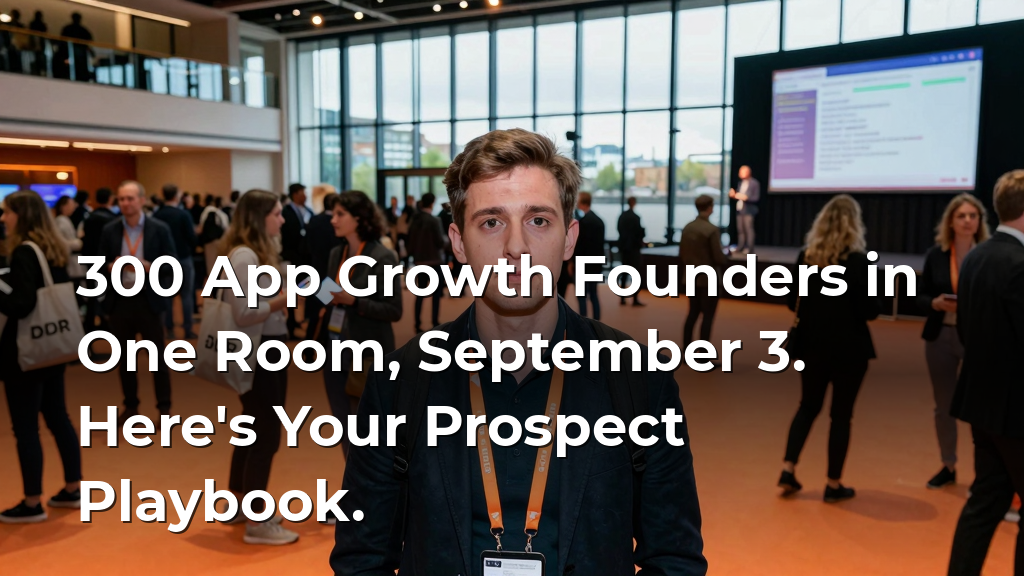
App Growth Summit London 2026 is confirmed for Thursday, September 3 at Tower Hotel. 300+ app growth experts, 30 speakers, 12+ sessions. If you sell into the app economy, this is the highest-density room of qualified prospects you'll find in the UK this year.
Why this conference beats the usual London circuit
Most London tech events are 80% vendors selling to each other. App Growth Summit is different. The speaker list reads like your ICP spreadsheet: growth leaders from Supercell, Vinted, Just Eat Takeaway, and Snap. But the real structural advantage is less about the names and more about the format. A full-day, single-track conference forces a specific kind of attention that the usual circuit fragments. At a multi-stage event, your target is pulled between talks, demo booths, and networking lounges. Here, the agenda is linear. That means the person you want to talk to is either in a session or on a scheduled break. You can map their movement. You can position yourself near the coffee station at the exact moment the Vinted talk ends. That is not luck; that is process.
These are the people who own budgets for user acquisition, retention tooling, and analytics platforms. They are not browsing LinkedIn for content. They are in a room, for a full day, with their guard down. The regulatory angle matters too. With ATT and GDPR reshaping how growth teams attribute installs, the conversations at this event will be less about vanity metrics and more about post-IDFA measurement, consent-driven data flows, and the operational cost of compliance. That is a different kind of sales conversation. It is consultative, not transactional. You are not pitching a tool; you are diagnosing a workflow problem that has a legal dimension.
For a founder or solo SDR, that is worth more than a month of cold outreach. One conversation with a Vinted growth lead can shortcut 40 cold emails. But only if you arrive with a thesis about their current stack, not a generic pitch. The summit gives you the context to do that. The rest is execution.
What the agenda actually covers
The 12+ sessions span the full app growth stack, but the real value is in how the agenda sequences them. Paid acquisition in a post-ATT world isn't just about SKAdNetwork tweaks; it's about re-architecting your measurement layer to tolerate signal loss while still optimizing toward downstream events, not just installs. Retention loops that survive iOS updates means building engagement mechanics that don't depend on IDFA or push notification permissions—think in-app value milestones and cross-platform sync that keeps users sticky even when Apple changes the rules mid-cycle. Creative testing at scale without burning budget is less about tooling and more about a disciplined hypothesis framework: you need a clear taxonomy for what constitutes a "new" creative versus a variant, and a statistical threshold for killing losers before they eat your CAC. Subscription pricing psychology for 2026 will likely address the shift toward annual plans and bundling, but the deeper question is how to frame price anchoring when users are increasingly price-comparing across apps in the same category—expect talk on decoy tiers and trial-to-paid conversion mechanics that don't rely on dark patterns. Finally, AI-driven personalisation that doesn't creep users out is the hardest session to pull off; the line between "helpful" and "surveillance" is thin, and the speakers will need to show how to use behavioral signals without crossing into explicit data collection that triggers privacy fatigue. No keynote fluff. No "state of the industry" panels with five people agreeing with each other. These sessions are tactical, and the speakers are practitioners who run growth teams, not consultants who read about them—so expect war stories, failed experiments, and the kind of operational detail you can apply the next morning.
How to work the room as an SDR
You are not there to learn. You are there to build pipeline. Here is the playbook we would run.
Before the event, pull the speaker list and the registered attendee list if it is public. Build a target list of 30 accounts. Use Apollo or Clay to enrich the contacts. Draft a short, specific email referencing their session topic. Send it three days before the event. Ask for 10 minutes at the coffee break. The key is to frame that request around a discrete problem they have likely encountered in their own growth experiments — not around your product. If you can reference a specific slide from their last public deck or a metric they shared on LinkedIn, you move from vendor to peer.
At the event, skip the first two sessions. Stand near the registration desk or the coffee station. That is where the conversations happen. Speakers will cycle through between sessions. Catch them then, not on stage. When you do connect, your objective is not to pitch. It is to extract one piece of information: their current priority for the next quarter. That single data point will shape your follow-up more than any slide they present. If they mention a bottleneck, note it verbatim. If they deflect, ask about their team structure or hiring plans — that often reveals where the pressure sits.
After the event, send a follow-up within 24 hours. Reference something specific from their talk or your conversation. Attach a one-page brief on how your product solves the exact problem they mentioned. Do not send a generic "great to meet you" LinkedIn request. Instead, include a single, concrete observation about their funnel or their pricing model that they can verify in under two minutes. That is what separates a memory from a meeting. The goal is not to be remembered as the person who said hello — it is to be remembered as the person who understood the problem before the conversation ended.
What this means for your outbound calendar
If you sell into app companies, September 3 is a strategic asset. Block the week around it. Use the event as a reason to reach out to prospects who have gone cold. The key is to anchor your outreach to the specific agenda, not just the event name. With 30 speakers confirmed, you can reference a session that aligns with your prospect's likely pain point—attribution, retention, or paid user acquisition. That specificity signals you have done your homework, which is the difference between a template and a tailored opener.
"Are you attending App Growth Summit London? I'll be there. Want to grab 10 minutes between sessions?"
That email works. It is low-pressure, time-bound, and gives the prospect a reason to respond. We have seen this pattern work across dozens of verticals. Events are the oldest excuse in the book, and they still work because they are genuine. But the real leverage is in the sequencing. Send the first touch 10–14 days out, when attendees are finalizing their schedules. Follow up 48 hours before the event with a lighter ask—"If you are slammed, no worries, but I will be near the registration desk at 11." That second touch often catches the people who have not yet committed to a full agenda and are open to filling gaps.
One caveat: this only works if you are actually attending. Do not fake it. People check. And if you cannot make it, use the event as a trigger to reach out to attendees with a piece of content about the topics being covered. That still gets you a reply rate above baseline. The deeper point is that your outbound calendar should treat conferences as anchors for a two-week campaign window, not a single-day spike. Pre-event outreach warms the pipeline; post-event follow-up—referencing a specific talk or a question you wished you had asked—extends the shelf life of the conversation. That structure turns a one-day conference into a sustained sales motion.
The cost-benefit math for a solo founder
Tickets are not cheap. But compare the cost to your CAC from cold outreach. If you close one mid-sized app client from this event, it pays for itself a hundred times over. The math only works, though, if you treat the ticket as a sales operations expense, not a marketing line item. That means pre-booking meetings before you board the train, not hoping the badge does the work. We have seen founders walk out of similar events with three qualified meetings and one signed pilot. That is a better conversion rate than any outbound sequence we have ever run. The reason is simple: at a conference, you are not interrupting anyone. The prospect has opted into a commercial context for the day. Your cold email is an intrusion; your conversation at the coffee station is a scheduled part of their workflow. That shifts the burden of proof. You do not need to earn attention, only relevance. For a solo founder, the real cost is not the ticket — it is the opportunity cost of a full day away from delivery. So you must pre-filter the speaker list and attendee roster. Skip the keynotes you can watch later. Target the 20 percent of people who fit your ICP and book 15-minute slots in the breaks. The Tower Hotel location is also a factor. It is on the river, close to Tower Bridge, and the venue is compact. You will not be walking between halls. Everyone is in one space. That density is exactly what you want for networking. You can cover the entire floor in two hours and still have time for a proper sit-down with two or three high-value prospects. The cost-benefit only breaks down if you treat it as a passive event. Treat it as a sales sprint, and the ROI is structural, not speculative.
What we would do next
Register early. The 300-person cap means this sells out. Then spend the two weeks before the event building your target list and sending those pre-event emails. The work you do before the conference determines what you get out of it. But "building a list" is not a single task—it is a triage process. You need to separate the 30 speakers from the 270 attendees, because the speakers are booked for the full day and will be harder to pin down. Your pre-event outreach should prioritize the mid-tier attendees: heads of growth at Series A/B companies who are not on stage and therefore have more slack in their schedule. Score those contacts by two variables: their likelihood of replying (based on recent activity, not job title) and their potential as a channel partner versus a direct customer. A founder at a complementary tool is worth more than a marketing lead at a competitor, because the founder can introduce you to five other founders in their network.
Second, use the two-week window to run a micro-campaign that tests your messaging before you spend the actual event time on it. Send a low-volume, high-personalization email to 20–30 of your lowest-priority prospects. Measure which angle gets replies: the "we solve your onboarding drop-off" angle or the "we cut your outbound reply time in half" angle. That data becomes your talking track for the event itself. Do not walk into the room with a generic pitch. Walk in with a specific problem statement that you know resonates because you have the reply rates to prove it.
Finally, book your meetings before you board the plane. The event app will open its networking scheduler roughly ten days out. Do not wait for the day-of scramble. Send a calendar hold to every high-score contact with a specific time slot and a one-line agenda. If they decline, you still have the list to work in the hallway between sessions. The people who treat the conference as a series of serendipitous encounters will leave with a bag of stickers. The people who treat it as a sales operation will leave with a pipeline.
If you want to see how we help founders build and score prospect lists for events like this, give MiraReach a try. We find the accounts, score the inboxes, and draft the pre-event outreach so you can focus on the handshakes.
— Mira