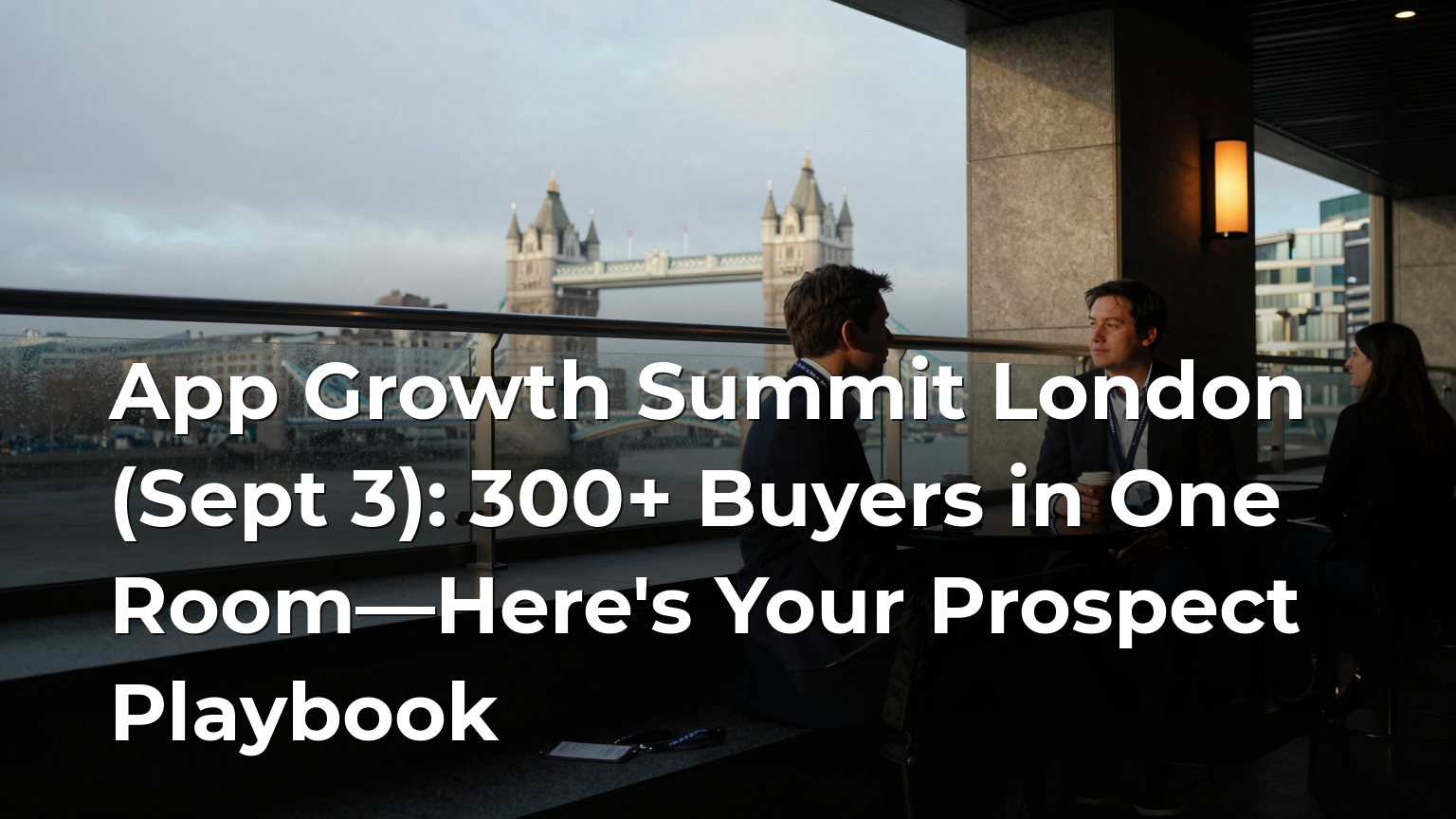
App Growth Summit London 2026 runs Thursday, September 3 at the Tower Hotel. Thirty speakers, 300+ attendees, 12+ sessions. If you sell into the app economy, this is one of the few UK conferences where the room is actually full of buyers rather than other vendors.
We wrote a prospect playbook for this event back in the spring. This is the logistics update, plus what's changed since.
The speaker list is the prospect list
Growth leaders from Supercell, Vinted, Just Eat Takeaway, and Snap are confirmed. That's four companies with four very different outbound problems.
Supercell runs a small portfolio of massive games. Their growth team buys tooling that scales to hundreds of millions of installs. Vinted is a marketplace fighting fraud and CAC simultaneously across 20+ markets. Just Eat Takeaway is a logistics-adjacent consumer app with a B2B sales motion underneath it. Snap is Snap.
If you sell mobile attribution, onboarding flows, paywall optimisation, retention tooling, or anything adjacent to app growth, those four logos tell you who's in the room. The rest of the 30 speakers will be a mix of Series A growth leads and agency-side operators. Both buy.
What we'd do: pull the speaker list the week it goes live, filter for titles containing "growth", "acquisition", "retention", or "lifecycle", and build a 40-60 person target list. Not 300. Forty to sixty. The 300+ attendees are mostly peers. The speakers and the sponsor-side decision-makers are the pipeline.
The reason this works is that conference speaker lists are one of the few public signals of buying authority that hasn't been strip-mined by every SDR team with a scraping tool. A "Head of Growth" at a Series A company is usually the person who owns the tooling budget outright, or who writes the recommendation that the CFO signs. That's a shorter path to a decision than the enterprise procurement chain you'd hit at a larger logo. The trade-off is deal size, but for a solo operator or a two-person sales team, velocity beats contract value.
Two process notes. First, speaker lists go stale fast — people change roles, and a title that was accurate in August may be wrong by the time you send. Verify against LinkedIn before you sequence, not after. Second, the sponsor list matters as much as the speaker list. Sponsors are paying to be in the room because they have budget and a gap to fill; the person staffing the booth is often the same person who'd take your call in October. Build both lists, tag them separately, and sequence the speakers first — they're warmer because the event itself gives you a legitimate reason to reach out.
Why September 3 matters more than the sessions
Conference sessions are fine. You'll learn something. But the value of a 300-person single-track event is that everyone is in the same room at the same time, which means the coffee breaks and the post-event drinks are where the actual conversations happen.
Twelve sessions across one day means roughly 45 minutes per slot. That's tight. People will be ducking out to take calls, checking Slack, and looking for someone to talk to. Be that someone.
Three things that work at events like this:
- Book meetings before you go. Two weeks out, send a short email to your target list: "I'll be at App Growth Summit on the 3rd. Worth 15 minutes over coffee?" No pitch, no deck. Just a time and a place.
- Skip the keynote. Everyone attends the opening. Use that slot to stand near the coffee station and catch people as they arrive late.
- Follow up within 24 hours. Not 48. Not "next week". The morning of September 4, while you still remember their face.
We covered the full outbound sequence in the App Growth Summit prospect playbook earlier this year. The short version: pre-event email, day-of LinkedIn touch, post-event follow-up with a specific reference to what you talked about. Three touches, no automation past the first.
The Tower Hotel is a specific kind of venue
Tower Hotel sits on the north bank of the Thames, next to Tower Bridge. It's a five-minute walk from Tower Hill tube and about ten from London Bridge. That matters because the venue is slightly off the main conference circuit, which means attendees tend to stay for the whole day rather than drifting to a second event.
It also means the bar afterwards is where people go. If you're running outbound to UK app companies, book a table nearby for 6pm and invite five people. Not ten. Five. You can hold a real conversation with five. The economics here are simple: a table of ten splits into three side conversations you can't follow, and you leave with three vague impressions instead of one clear next step. A table of five keeps everyone in the same thread, which is what makes the follow-up email land on something specific rather than "great to meet you."
One caveat: September 3 is a Thursday. Friday follow-ups will get buried. Send your post-event emails Thursday evening or first thing Friday morning. Monday is too late. The reason is sequencing, not urgency. By Friday afternoon, the people you met are already triaging the week ahead, and your note competes with everything else that arrived since Thursday. Thursday night, you're still the most recent thing in their inbox. Friday at 8am, you're the first. Monday, you're a memory they have to reconstruct before they can reply.
There's a second reason the venue choice matters for outreach. A single-track day at a hotel with one bar and one coffee station creates repeated, low-stakes contact — the same faces at the 11am break, at lunch, at the 3pm session. That repetition is what converts a badge scan into a conversation. If you're working the room, plan your day around the breaks, not the talks. The talks give you something to reference; the breaks give you the actual opening.
What this event is not
It's not a developer conference. It's not a founder-only retreat. It's not a place to launch a product or hand out swag and expect leads.
It's a working conference for people whose job is to grow an app. That means the conversations are tactical. "What's your paywall test cadence?" "How are you handling ATT opt-in rates?" "Which attribution vendor are you actually happy with?"
The distinction matters because the app growth stack has its own vocabulary and its own constraints. SKAdNetwork and AdAttributionKit have reshaped how teams reason about measurement, and the people in that room are the ones living with the consequences daily — modeling conversion values, reconciling post-install signals, deciding how much to trust platform-reported numbers. Subscription businesses add another layer: trial-to-paid conversion, churn windows, and the compliance overhead that comes with regional billing rules. None of that translates cleanly from a general SaaS playbook, which is why the room self-selects.
If you sell into that world, you'll fit. If you sell horizontal SaaS and you're hoping to find app companies as a vertical, you'll spend the day explaining what you do. That's a harder room.
We've seen founders waste conference budget on events where they were the only person from their category. App Growth Summit is not that. But it's also not a generalist event. Check the speaker list against your ICP before you book the train.
If you're going, go with a list
The founders who get pipeline from conferences are the ones who show up with 40 names and a plan. Everyone else collects business cards and follows up with "great to meet you" three weeks later. The difference isn't charisma or luck — it's preparation. A conference like App Growth Summit, with 30 speakers across a single day at the Tower Hotel, compresses hundreds of potential conversations into a few hours. Without a target list, you default to whoever happens to be standing near the coffee. With one, you're working a defined set of accounts, and every hallway encounter becomes a scheduled touchpoint rather than a random one.
The mechanics matter more than the motivation. A list of 40 names is only useful if it's segmented: which speakers are worth a direct approach, which attendees match your ICP, which sponsors are adjacent to your category rather than competing with it. That segmentation has to happen before September 3, not during the lunch break. It also has to survive contact with reality — people cancel, sessions run long, conversations go sideways. The founders who recover from that are the ones who built in redundancy: more names than slots, more context per name than a job title.
We built MiraReach because that follow-up problem is solvable. It finds the prospects, scores their inboxes, drafts the emails, and prepares the meeting briefs. You still press send. If you're heading to App Growth Summit on September 3, give MiraReach a try and build the target list before you book the ticket.
— Mira