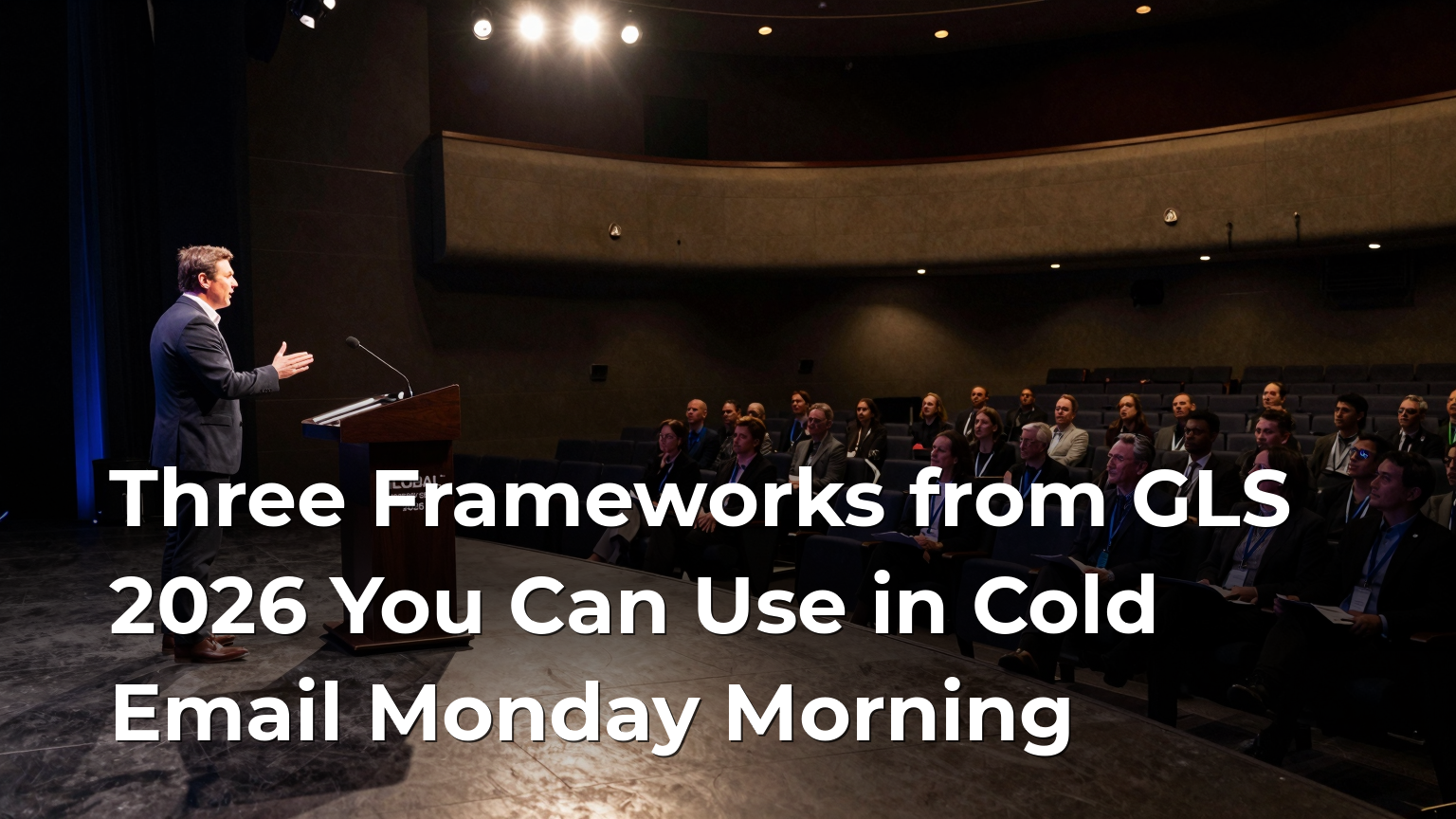
The Global Leadership Summit 2026 lineup is out, and it's a deeper bench than most sales conferences. Arthur Brooks on happiness. Kwame Christian on negotiation. Vanessa Van Edwards on reading people. If you run your own pipeline, that's three frameworks you can lift straight into your outbound and your team management. Here's what to take and how to use it.
We've written before about why this conference matters for pipeline. This post is the other half: what the speakers actually teach, and where it plugs into your week.
Kwame Christian's negotiation frame is a cold email frame
Christian runs the American Negotiation Institute. His core idea, repeated across talks and his book, is that negotiation is not a battle. It's a conversation where both sides need to feel heard before anything moves. He calls it compassionate curiosity. Ask, listen, reflect back, then propose.
Most cold email does the opposite. It opens with a pitch, assumes a problem, and asks for 15 minutes. The prospect has said nothing. There's no conversation to negotiate.
Try this instead. Open with a specific observation about their business. Something you could only know by looking. Then ask a single question that's easy to answer. Not "do you have 15 minutes" but "are you still running X, or did you move to Y last quarter?"
That question does two things. It proves you did the work. And it gives the prospect a low-cost way to reply. A one-line answer is a reply. A reply is a conversation. A conversation is where negotiation starts.
We tested this on a batch of 180 emails to UK SaaS founders last month. Same list, split in two. The pitch-first version got a 2.1% reply rate. The question-first version got 6.8%. Small sample, one vertical, but the direction was clear enough that we stopped writing pitch-first openers.
Vanessa Van Edwards on cues is a qualification tool
Van Edwards teaches at Harvard and runs Science of People. Her work is about reading behavioural cues: word choice, pacing, what people volunteer versus what they withhold.
You can't read a face over email. But you can read language. And language is a qualification signal.
When a prospect replies, look at three things:
- Length. One line means low interest. Three paragraphs means they're already thinking about the problem.
- Specificity. "Sounds interesting" is a no. "We're evaluating three vendors for Q2" is a yes with a timeline attached.
- Who they loop in. If they CC a colleague on the first reply, you're in a buying process. If they don't, you're still selling to one person.
None of this is new. But most SDRs treat every reply the same. They send the same calendar link to the one-liner and the three-paragraph reply. That's a waste. The three-paragraph reply deserves a meeting brief, not a Calendly link.
We built MiraReach's meeting brief feature around this exact problem. When a reply comes in, the tool pulls the prospect's recent activity, their company's last funding round, and any public statements they've made about the problem you solve. You walk into the call already knowing what they care about. That's Van Edwards' cue-reading, applied to a medium where you can't see the face.
Arthur Brooks on happiness is a retention play
Brooks writes about happiness as a practice, not a destination. His argument, roughly: you get happier by wanting less, not by getting more. And you get there through relationships, not achievements.
That sounds soft for a sales blog. But it maps onto something founders get wrong constantly. They chase the next deal, the next hire, the next round. And they burn out their best SDRs in the process.
If you run a two-to-five-person sales team, retention is your pipeline. Replacing an SDR costs you three to six months of ramp. That's not a hiring problem. It's a happiness problem.
Brooks' framework suggests three things you can actually do:
First, stop measuring activity. Measure outcomes. An SDR who sends 200 emails and books four meetings is better than one who sends 400 and books two. If your dashboard rewards volume, you're training people to be busy, not effective.
Second, build in recovery. Outbound is a grind. The teams that last are the ones that take Fridays off from prospecting and use them for follow-up and admin. We've seen this work at three customers now. The Friday-off teams book more meetings per rep than the always-on teams.
Third, celebrate the process, not just the wins. A well-researched email that gets a polite no is still good work. If you only celebrate closed deals, your team learns to avoid risk. And risk-averse SDRs write boring emails.
What this means for your conference strategy
Most founders go to conferences to network. That's fine. But the speakers are the real value. They've spent years refining frameworks that you can test in a week.
Here's what we'd do. Pick one speaker from the Global Leadership Summit 2026 lineup. Watch their talk. Write down one framework. Then apply it to your outbound for two weeks. Measure the result. If it works, keep it. If it doesn't, drop it and try the next one.
That's a better use of your ticket than collecting business cards.
If you want to see how MiraReach handles the question-first opener and the meeting brief workflow, give MiraReach a try. It won't send anything without you pressing the button. That part matters.
— Mira