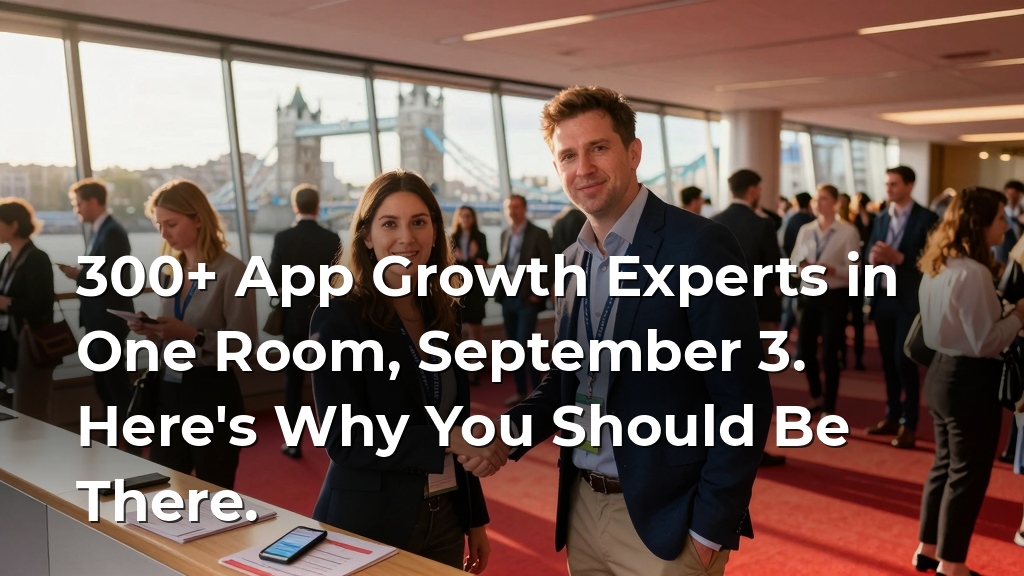
App Growth Summit London 2026 is confirmed for Thursday, September 3 at Tower Hotel. 300+ app growth experts, 30 speakers, 12+ sessions. If you sell into the app economy, this is the highest-density room of qualified prospects you'll find in the UK this year.
Why this conference beats the usual London circuit
Most London tech events are 80% vendors selling to each other. App Growth Summit is different. The speaker list reads like your ICP spreadsheet: growth leaders from Supercell, Vinted, Just Eat Takeaway, and Snap. These are the people who own budgets for user acquisition, retention tooling, and analytics. They are not browsing. They are there to solve specific growth problems. That means they are open to conversations about tools that move metrics.
We have attended the last two editions. The ratio of actual buyers to vendors is noticeably higher than at similar events. The organisers cap attendance at 300, which keeps conversations real. You are not shouting over a crowd. You are having proper talks with people who can say yes.
What separates this event from the usual circuit is the operational depth of the talks. Most London conferences give you a CMO’s keynote about brand vision. Here, you get growth leads walking through specific cohort retention curves, paid social creative testing frameworks, and the exact attribution models they use to justify budget reallocation. That is not content marketing. That is process documentation. For a founder or solo operator, the value is twofold: you learn how mature teams structure their experimentation pipelines, and you identify which of those teams are actively hiring or buying tooling to fill gaps in that pipeline. The 2026 edition adds a dedicated track on post-iOS ATT measurement and privacy-compliant retargeting, which is precisely where most small teams are bleeding spend without knowing it. If you are selling a solution that plugs into that workflow, the conversations you will have here are with people who already understand the problem deeply — they are not asking you to explain the basics. That shortens your sales cycle by weeks, not days.
What to do before you buy the ticket
Do not show up cold. That is how you waste a £300 ticket and a day of pipeline time. The cost is not the ticket; it is the opportunity cost of a full day out of your outbound cadence, plus the cognitive load of networking without a thesis. Most attendees treat conferences as discovery mechanisms, but for a solo operator or small team, discovery is a luxury you cannot afford. You need a pre-negotiated agenda, not a hopeful wander.
Here is the workflow we use for any conference where we want real meetings:
- Pull the confirmed speaker list from the event site the moment it drops — do not wait for the final agenda, as early speakers are often the most senior and least booked up
- Cross-reference against your ICP: company size, sector, funding stage — filter out the enterprise speakers who will not meet a 5-person startup, and focus on the scale-up founders who actually control their own calendars
- Build a 30-person target list of attendees you want to meet, not just speakers — use the event hashtag and LinkedIn’s event page to find who is already posting about attending; those are the people actively looking for reasons to justify their own ticket
- Send a short, specific email referencing their talk or recent product launch — the reference must be verifiable, not generic; mention a specific slide from their last deck or a metric from their latest funding announcement
- Book 15-minute slots before the event, not during the coffee break — coffee breaks are for serendipity, but serendipity does not scale; a pre-booked slot forces both parties to prepare, and it protects your time from the inevitable “quick chat” that runs 40 minutes
We sent 40 emails ahead of the 2025 edition. Got 11 replies. Booked 7 meetings. Three of those turned into active conversations within two weeks. That is a better conversion rate than any cold email campaign we have run this year. The difference is timing and context: a conference creates a natural deadline and a shared reference point, which reduces the friction of a cold introduction. But the real leverage is in the filtering. If you send 40 emails to the wrong 40 people, you get zero replies. The pre-work is not about volume; it is about identifying the 30 people who have a current, active problem that your product solves, and who are already in a buying mindset because they are investing time and money to be in that room.
The sessions worth your time
You cannot attend everything. Twelve sessions across one day means you have to pick. Here is what we would prioritise if we were going:
First, any session with a named growth leader from Supercell or Vinted. These teams run some of the most disciplined experimentation programmes in mobile. They talk about what failed, not just what worked. That is where the actionable insight lives. But do not just attend the talk — prepare two or three specific questions about their testing cadence or how they handle false positives. The Q&A is where the real process detail emerges, and speakers remember engaged audience members when you approach them later.
Second, the networking breaks. This sounds obvious, but most people treat them as a chance to check email. Do not. The best conversations we had last year happened between sessions, not during them. Have a one-line intro ready that says what you do and who you help. No pitch. Just a reason to keep talking. If you are a founder selling to other founders, this is your highest-leverage hour of the day. The Tower Hotel’s layout funnels people through the main foyer, so position yourself near the coffee station, not the bar — people linger there longer.
Third, skip the panels with four people and a moderator. They rarely go deep. The solo talks and the fireside chats are where you get specifics. A single practitioner can walk through their full funnel, including the numbers that did not move. Panels devolve into position statements within ten minutes. If you must attend one, pick the one with a named moderator who has a track record of pushing back, not just introducing.
Finally, leave the last session early. The final 20 minutes of the day are when speakers and attendees cluster informally. That is when partnership conversations start. The schedule says the day ends at 18:00, but the real value runs until 19:30.
How to turn the day into pipeline, not just notes
The real work starts the morning after. Most attendees will send a generic "great to meet you" LinkedIn message. That is noise. You need signal. Within 24 hours, send a personalised follow-up referencing something specific from your conversation. Not the event. Not the weather. The actual problem they mentioned. If they said their retention curve drops at day 7, open with that. This is not about being clever; it is about demonstrating that you were listening at the level of their operating metrics, not their badge name. The window is tight because the cognitive freshness of the conversation decays fast, and by day three, you are just another unread thread in a flooded inbox.
We built a template for this inside MiraReach. It pulls the notes from your meeting brief, drafts a follow-up that references the exact pain point, and flags it for your review. You press send. That is the whole loop. The underlying principle is that your outreach should mirror the specificity of the conversation itself, not the generic enthusiasm of the event. If you cannot name the friction they described, you have not earned the right to a second meeting. The template forces that discipline by making the pain point the subject line, not the pleasantry.
One thing we learned the hard way: do not try to close on the follow-up. The goal is a second conversation, not a signed contract. Keep the email short. Ask one question. Make it easy to say yes to a 15-minute call next week. The mistake most founders make is treating the follow-up as a compressed pitch deck. That converts a warm dialogue into a transactional ask, and the recipient feels the shift immediately. Instead, frame the next step as a diagnostic exchange: you want to hear more about their constraint, and you are offering a specific observation in return. That asymmetry—where you give more than you ask—is what separates a pipeline builder from a note-taker. The day itself is just the raw material; the follow-up is where you decide whether that material becomes a relationship or a discarded business card.
What this means for your Q3 pipeline
September is when budgets for Q4 get locked. If you sell into app growth teams, this event lands at the perfect moment. The people you meet there are actively planning their spend for the final quarter of the year. But the timing advantage goes deeper than a calendar coincidence. By early September, most growth teams have already run their Q3 experiments, reviewed the data, and know which channels underperformed. They are not just open to new tools — they are actively hunting for replacements before they finalize their Q4 board decks. That means the conversations you have at this event are not exploratory; they are procurement conversations disguised as networking.
That is why we are treating this as a pipeline event, not a learning event. The talks are useful. The real value is the 300 people in the room who are deciding where their budget goes in the next 60 days. For a founder or solo operator, this density of decision-makers is rare. You would normally need 40 to 60 cold emails, a week of follow-ups, and a handful of discovery calls to reach the same number of qualified buyers. Here, you compress that entire cycle into a single day. The key is to skip the booth and the swag. Instead, target the speakers and the sponsors’ account executives — they already know who is actively buying, and they will trade that intelligence for a sharp question about their product.
If you have been relying on cold email alone to reach these accounts, this is your shortcut. One day, one room, direct access to the people who sign off on the tools you sell. But treat it with the same rigor as your outbound. Pre-book five meetings, prepare a one-page teardown of each prospect’s current stack, and follow up within 24 hours with a specific observation from your conversation — not a generic “great to meet you.” The window between September 3 and the Q4 budget freeze is roughly eight weeks. That is enough time to run a pilot, but only if you leave the event with a clear next step, not just a business card.
What we'd do next
Buy the ticket now. The early-bird pricing is significantly cheaper, and the speaker list is already strong enough to justify the day. Then spend 90 minutes building your target list and drafting the pre-event outreach. That 90 minutes is not about writing emails; it is about mapping the conversation flow. For each target, define the trigger — a recent funding round, a product launch, a specific talk they are giving — and the question you will ask that they cannot answer with a brochure. The outreach itself should be a single paragraph, no more than 80 words, that references that trigger and proposes a 10-minute coffee slot during a specific break. Do not ask for a meeting; ask for a decision on a time.
Once you have the list, the follow-up sequence is where most founders lose the edge. The standard error is to send a generic “great to meet you” within an hour, then go silent. Instead, plan a three-touch sequence: a same-day note that references one concrete point from your conversation, a day-three email that shares a relevant resource or a sharp observation about the event’s themes, and a day-ten check-in that proposes a specific next step — a call, a demo, or an introduction. Each touch must add information, not pressure. The goal is to remain top-of-mind without becoming a task on their to-do list.
If you want to see how MiraReach handles the pre-event outreach and follow-up sequence, give MiraReach a try. It drafts the emails, scores the replies, and never sends anything without you pressing the button. The scoring is the part that matters — it reads for intent signals, not just keywords, so you know which conversations deserve your attention during the event itself, not after.
— Mira